
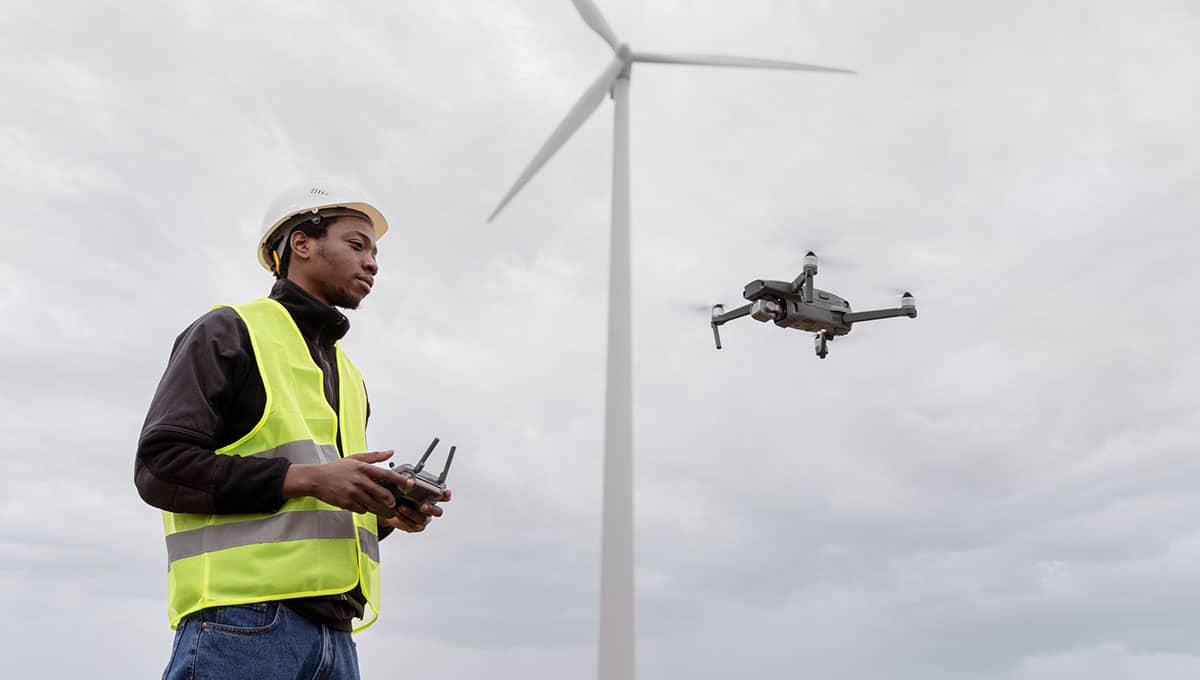
Considering an aerial survey for your Western Australian construction project? It’s understandable. With targets and budgets in play, good information guides smart choices. You’ll likely encounter terms like Drone LiDAR and Drone Photogrammetry. So, what are these, and how do you determine a good fit for your job site? Let’s clarify.
What Are We Actually Looking At?
At LPD Surveys, this topic comes up often. Both LiDAR and Photogrammetry use drones for site mapping. Their main difference is how they “see” or record the world, which shapes the data collected and its best uses.
Drone LiDAR: Getting Down to Detail
LiDAR (Light Detection and Ranging) employs light for measurement. As an active system, the drone emits thousands of laser pulses per second. These pulses hit surfaces – ground, buildings, vegetation – and return to the sensor. By timing this round trip, LiDAR calculates distances very precisely. This builds a “point cloud” – a massive, detailed 3D map of your site.
- A Word on Vertical Accuracy: LiDAR is often noted for strong vertical accuracy, with some reports pointing to results in the 1-3 cm range. When exact land height details are needed for complex earthworks or drainage, LiDAR is something many consider.
- Seeing Through the Green Stuff: A handy LiDAR feature in WA, especially with our bushland, is its ability to gather data through vegetation. Some laser pulses can penetrate foliage to map the actual ground. This is valuable for a “bare-earth” model, important before clearing or design.
- Working Around the Clock (Almost): Using its own light source, LiDAR is less reliant on daylight, potentially offering scheduling flexibility. It also performs consistently in shadows or on overcast days.
Drone Photogrammetry: Capturing the Bigger Picture Visually
Photogrammetry operates differently as a passive system. It uses a high-resolution camera on the drone to snap many overlapping photos of your site, needing decent ambient light. Clever software then analyses these images, finding common points to calculate their 3D positions.
- Great for Visuals: Photogrammetry’s strong point is its visually rich information. You can get high-resolution orthomosaics (accurate, measurable aerial maps) and realistic 3D textured models, often useful for progress tracking, site documentation, or presentations.
- Thinking About the Budget: In certain situations, photogrammetry might be a more budget-conscious mapping choice, particularly initial costs. This sometimes makes it a popular avenue for residential land surveys where a good visual overview is key.
- Good for Open Sites: For clear, open sites without dense vegetation obscuring the ground, photogrammetry is known to produce solid mapping and surface model results.
So, Which Way to Go for Your WA Project?
There isn’t a single “magic bullet.” It’s about matching a land surveyor Perth technology’s strengths with your project’s specific needs.
Times You Might Think About LiDAR:
- When Accuracy is Top of the List: Particularly if vertical accuracy is vital for engineering design, precise grading, or as-built verification. If you’re consulting a licensed surveyors Perth for a job needing finer precision, LiDAR capabilities would likely be discussed.
- If You’re Dealing with Vegetation: When mapping the actual ground level under trees or scrub is important. This can be a key factor for subdivision surveyors Perth planning new developments in greener areas.
- For Tricky Lighting or Uniform Surfaces: If the site has poor light, shadows, or large, uniform areas (fresh concrete, sand) where other systems might struggle with feature recognition, LiDAR’s approach could be beneficial.
- Needing Detailed 3D Geometry: When the main outcome is a geometrically precise 3D model, perhaps for checking against complex designs.
When Photogrammetry Could Be a Good Fit:
- If Visuals are Key: When you need high-quality photos, clear orthomosaics, or realistic-looking 3D models for progress reports or stakeholder communication.
- For Open, Clear Sites: Where minimal vegetation allows a clear camera view of the ground.
- When the Budget is a Major Factor: If good, useful data is needed, but the absolute highest precision isn’t a strict requirement. The land surveyors Perth cost can play a role here.
- For Regular Progress Checks: For periodic site status updates, provided conditions suit photo capture, photogrammetry can be practical.
What About Using Both? The Hybrid Idea
It’s not always an either/or. For some complex WA projects, a hybrid approach, using both LiDAR and photogrammetry, gets considered. LiDAR might provide an accurate bare-earth model, while photogrammetry captures detailed aerial photos. Combining these datasets can offer precise measurements with rich visual context, aiming for the best of both.
Making the Call for WA Conditions
Western Australia’s landscape is varied. Understanding your site, project goals, and information needs is a big part of planning. If you’re looking for a land surveyor near me, finding one who understands these technologies and their application to land surveys Perth can simplify the process.
At LPD Surveys, we aim to provide spatial data that helps our clients make well-informed decisions, supporting their project goals here in WA.