
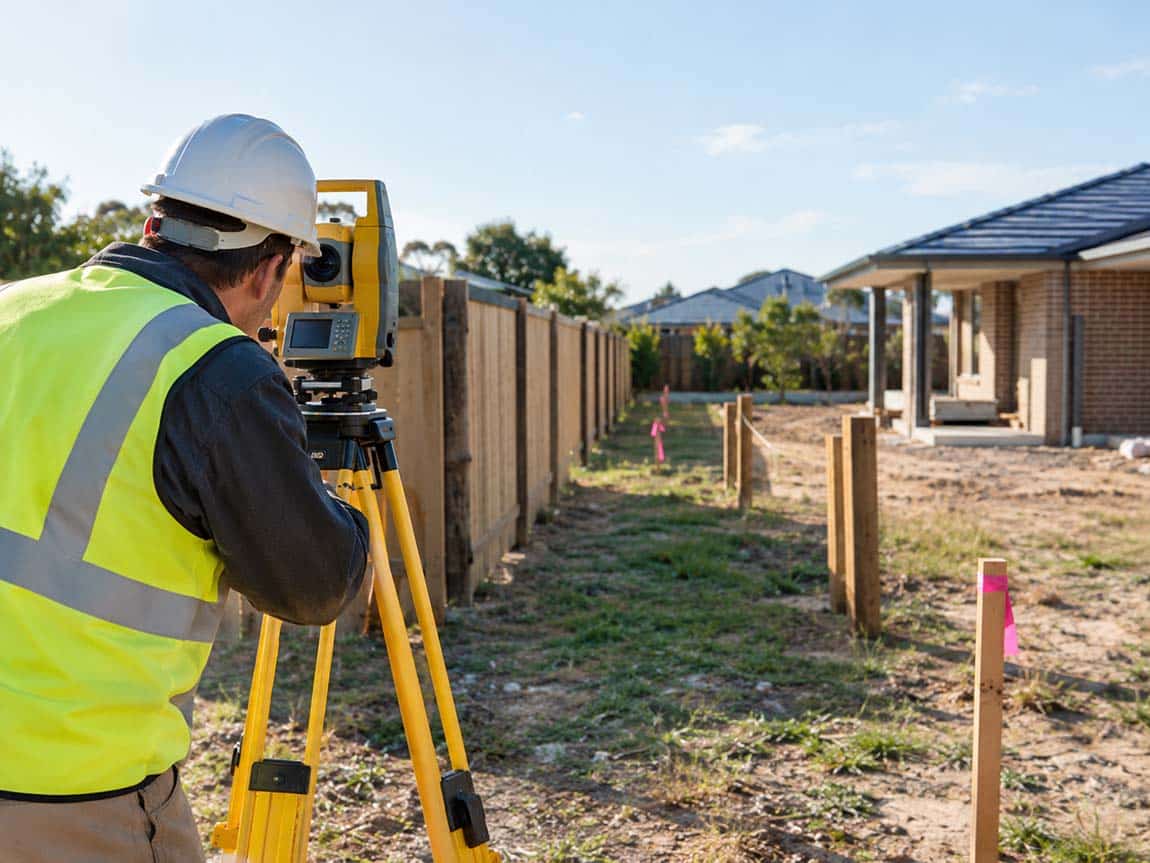
Building a fence, extension or new home requires an accurate understanding of where the legal property boundary lies.
Existing fences and retaining walls do not necessarily follow the title boundary, and survey marks may be missing or disturbed. For work on or near a boundary, a licensed surveyor establishes and marks the legal boundary before construction begins.
What a boundary survey tells you
A boundary re-establishment, sometimes called a re-peg survey, determines the legal position of an existing property boundary and marks it on site. The surveyor considers registered survey information, previous survey evidence and measurements taken at the property.
An identification survey shows how existing improvements, such as buildings, walls or fences, relate to those boundaries. The two services often apply to building projects, but they answer different questions.
If you are unsure which service applies, a licensed land surveyor can review the proposed works and determine the appropriate survey scope.
Before building or replacing a fence
A survey is worth considering whenever a new fence is intended to follow the property boundary, particularly where no reliable survey marks are visible.
Replacing an existing fence in the same location does not prove that the new fence will be on the legal boundary. The previous fence may have been offset, erected without a survey or altered over time. Building along the same line can carry that discrepancy forward.
The same concern applies to retaining walls and other permanent work close to a property line. Once posts, footings or walls have been installed, correcting their position is more disruptive than establishing the boundary first.
A boundary survey gives the contractor a surveyed line rather than an assumed one.
Before an extension, garage or other addition
Extensions often bring a building closer to a side or rear boundary. Accurate boundary information may therefore be needed while plans are still being prepared.
This can apply to house extensions, garages, carports, sheds and retaining structures. Where a designer is working to required setbacks or trying to use a narrow part of a lot, measurements taken from an existing fence can give a misleading picture of the available space.
Surveying early also allows existing improvements to be related accurately to the title boundary. That information can be used by the designer, engineer or builder before construction.
For metropolitan projects, LPD Surveys’ land surveyors in Perth work with property owners, builders and designers on boundary and site survey requirements.
Before building a new home
New homes commonly require several types of survey work, and they should not be treated as interchangeable.
A boundary re-establishment identifies the legal limits of the lot. A feature and contour survey records relevant site features and levels for design. Construction set-out later transfers the approved building position onto the site so the builder knows where the structure is to be placed.
If the boundary position is uncertain, resolving it before the house design is finalised gives the designer reliable site dimensions. It can also reduce the chance of altering plans because the available building area was based on an assumed fence line.
Property owners in the Peel region can speak with LPD’s Mandurah land surveyors about boundary, property and construction surveys.
Why the title plan is not enough on its own
A title or deposited plan records the legal dimensions and configuration of a property, but it does not physically mark those boundaries on the ground.
Features such as fences, kerbs, retaining walls and building corners should not be treated as reliable boundary markers unless their relationship to the title boundary has been confirmed by survey. They may have been built with an offset, moved during later works or positioned from approximate measurements.
When the exact boundary location is needed for construction, fencing or design, a licensed surveyor can re-establish the boundary using registered survey information and evidence found on site.
Frequently asked questions
Do I legally need a boundary survey before building a fence in WA?
Not every fencing project automatically requires a new boundary survey. If the fence is intended to sit on the legal boundary and its position is uncertain, having the boundary re-established is a sensible step before construction. Other fencing requirements may also apply, including local government rules and obligations between adjoining owners.
Can I use the existing fence as the property boundary?
You should not assume that an existing fence marks the exact legal boundary. A fence may have been deliberately offset, built from approximate measurements or replaced without the boundary being re-established. A licensed surveyor can determine how the fence relates to the title boundary.
What is the difference between a re-peg survey and an identification survey?
A re-peg or re-establishment survey determines and marks an existing legal boundary. An identification survey records the relationship between that boundary and improvements on the land, such as buildings, walls and fences.
Do I need a boundary survey before building an extension?
It may be needed where the extension is close to a property boundary, where setbacks depend on accurate boundary information, or where the existing boundary position is uncertain. It is usually more useful to obtain the survey while the extension is being designed rather than after construction has begun.
Is a boundary survey the same as building set-out?
No. A boundary survey establishes the legal property boundary. Building set-out marks the location of the proposed building or other works using the approved design. A project may require both at different stages.
Arrange the survey before work starts
If a fence, retaining wall, extension or new home will be built on or close to a property boundary, send LPD Surveys the property address together with any title information, plans or proposed drawings you already have.
Our licensed surveyors can review the job and advise whether a boundary re-establishment, identification survey, feature survey or construction set-out suits the project. Confirming the survey scope early gives your designer or contractor reliable site information before work begins.
